
Materials: Arduino UNO R3 Starter Kit, Submersible Water Pump DC 12V 3.6W 9.8ft Lift, 9V Battery, 5V Wall charger, PLA Plastic
Monthly - Mark Rober’s Class - Electrical
January 2021
A water fountain that turns off when it reaches a specific temperature in this case ( 19°C or 66°F and 26°C or 79°F). Water Fountains are often used to create a peace of mind through white noise. Just as white noise helps create peace of mind so does the temperature of the room. This device keep track of the temperature and warn you when it gets either too hot or too cold for your taste.

Materials: Glass, PLA Plastic, and Rubber
Monthly - Mark Rober’s Class - Mechanical
January 2021
In this project I wanted to find a way to wash rice quickly, and also cleanly. While cleaning rice in America is not needed for the reasons of olden days. I clean rice so that I can remove the extra starch that is packed in from the milling phase. This extra starch in rice makes the rice gummy and not fluffy when you eat white rice by itself. Washing the rice removes that extra starch so that when cooked. The rice becomes fluffy. The methods traditionally used in my family is by shifting rice with a strainer in water. Using this method we end up dumping a lot of water down the drain and waste a lot of time. (Although washing rice is not a strenuous and long activity at most it is about 5 minutes).
I defined clean rice by being able to see each rice grain in the photos clearly and cleanly with no dust or fog in the water when in the rice cooker pot. While this sounds extreme when compared to cooking rice. This was done so that I could accurately tell which was cleaner. As normal rice does not need to be that clean for it to be fluffy rice. As well as the fact that you would just be removing all the nutrients that was dusted on during the miller phase.
For this build to be successful, it needed to use less water and time than the traditional method in washing rice. It also needed to hold a family size ( in my case 3 cups of rice) to be washed.
There were a lot of assumptions made that were overturned as I went through this project. It was not enough to just have water and rice with a little shake. It took a lot more effort to get to the state required to clearly tell which was cleaner.
One large assumption that was immediately overturned was the idea that spinning was all that was needed. During my experimental phase, I used various tools to spin in one direction and one place in the rice with little to no results within the first minute. On the other hand, swirling the water without touching by swirling the bowl cleaned the rice faster than the traditional method although it was in smaller quantities. At the time I did not understand why, and now I can guess why it did and why it worked in smaller quantities.
Going back through my notes to find new approaches I began to take a look into how grains were being mixed and came across this spiral. I took that design and began to play with it by removing parts of it and adding to it. I then redid my small tests and discovered that despite the volumes this spiral design was incredibly efficient in cleaning rice. By removing parts of the design I was able to see why this worked.
It all has to do with collision and the nature of starchy water and rice. By having a large space in between each spiral the water and rice is able to flow freely through it, but when shaken the rice and water collides into the spiral in a zig-zag fashion to the other side. As it has two spirals in opposite directions this meant that there were a lot of collisions made to remove the starch. This is evident when removing the inner spirals and the rice became less clean due to not having enough surface areas to bounce around. This is the explanation why spiraling the water worked in smaller tests. Because there was less water the rice was able to hit the bowl’s edges more frequently and allows the starch to be removed in comparison to spinning in one direction where the collision is in the center and the rest of the rice is moving in one direction. Barely hitting the walls of the bowl.
In theory if you have a super shaker it is possible to clean rice without an agitator, but this spiral agitator helps immensely. I do understand that there are other possible options such as creating more collision spaces by tightening the spiral or putting a mesh on top of it. Although upon examination in testing I find that the starchy water has difficulty in traversing the mesh (while I did not feel any difference the results were clear). There was a balance between space, and collision for a starchy water rice combo.
In order to use this item you would put in your rice and water. Cap the bottle and then just shake until a designated time. Usually about a minute. I want to comment and say that while it would have been better to create a shaking machine. I was not aware at the time that shaking was by far the best method. As the differences between swirling’s, stirring’s, and agitator’s results were quite similar to each other. It was not until I took apart the spiral that I understood why swirling water was able to clean the rice and that shaking help promote the zig-zag pattern.
For the final build this prototype was able to wash 1 cup of rice with 2 cups of water in 2 minutes and when scaled to family size of 3 cups of rice it took 12 cups of water in 4 minutes. Traditional method was 1 cup of rice with 6 cups of water in 6 minutes. On a family size of 3 cups of rice with 24 cups of water in 8 minutes. ( although this discrepancy has to do with the bowl size used to clean the rice - where the water barely touched the rice and the other completely submerged the rice)
I once again say that this type of cleanliness is not required or needed to have fluffy rice. In all honestly you could do it in half the amount and time to get the necessary cleaning. This was for this build so that I could tell which was cleaner. Most families do not measure water to clean the rice and often put in a random amount, but enough to submerge the rice. For this build it was able to hold 3 cups of rice and 6 cups of water and can be cleaned in 1 minute.

Bachelor’s Degree Project
May 2019
The focus of this project is to create objects based on ideals of the practice of meditation. These objects are then used to have a conversation about American Meditation as a whole and its market. The information provided is based on independent research as well as interviews with practitioners within Providence, Rhode Island.

Spring 2019
A series of collages of developed images done in a manner like Social Media

Dimensions: 15"L x 14"W x 24"H
Materials: Maple Paperback Veneer, aluminum tubing, rubber mounts, sheet steel, steel cables, magnets
February to May 2019

Dimensions: 15"L x 14"W x 24"H
Materials: Maple Paperback Veneer, rubber mounts, sheet steel
February to May 2019

Dimensions: 15"L x 14"W x 36"H
Materials: Maple Paperback Veneer, 1" diameter_1/16" wall thickness of mild steel tubing, Rubber Mounts, Powder Coating, Spray Paint
February to May 2019

Dimensions: 15"L x 14"W x 6"H
Materials: Maple Paperback Veneer
February to May 2019

Spring 2019
Developed photos taken when I was in Milan for RISD x Mabelo Furniture Show

What does it mean to be an expert in the field? What does it mean to the everyday person when they come across such an extraordinary person? How does someone comprehend the knowledge presented to them?
In this video, I show a conflicted world in which evidence, data, analysis, and speculation come into play discussing on how beneficial smoothies really are.

Extreme Height Chair / Cantilever Chair Extreme Prototype #1
Mild Cold Steel Tubular, Leather, Para cord Strings, Brass Rings
56" L X 30.5" W X 67" H
November - December 2018
Extremities was a project that would explore the limits of Furniture by taking furniture that had extreme on its label and push the concept further. This was the first chair and concept from this idea.

Stacking Bench Stool
Proposal: Wood and Galvanized Sheet Metal
20" L X 17" W X 16" H
October - December 2018

Mild Cold Tubular Steel, Sheet Metal, Spray Paint
25.75" L X 22" W X 35.5" H
October 2018
________________________________________________________________________________________________________________________________________________
Gallery Shows
Gelman Gallery Chair Show in Rhode Island School of Design at the Chase Center hosted by Hannah Bartlett and Raina Wellman - shown on March 18 - April 28 2019

Materials Maple Paperback Venner, Mild Cold Steel Tubing, Rubber
L15 inches X W14 inches X H25.5 inches
April 16- May 2018

A series of self-portraits on the subject of disbelief
________________________________________________________________________________________________________________________________________________
A Suspension of Disbelief
A desire to see the unexpected. The willingness to believe in the impossible. Many of us entertain ourselves with such thoughts of what ifs and how and what it could feel like. It is why we love things like levitation, flying, floating, or walking on water. Yet so is the opposite such as falling.
In this series I explored the creation of a suspension of disbelief by catching a moment before. This resulted in some fun moments within each image telling a story of its own.


Singular Modular Piece
Materials - Maple Paperback Veneer
L4 inches X W5 inches X H2 inches
March 2018

A series of photography about 14 pictures containing 14 word themes:
Ambivalent - Blue - Familiar - Forgotten - Homogeneous - Oblique - Outside - Reptilian - Scattered - Sensuous - Smart - Spinning

Plastic Cutlery Lighting Design Exploration
March 2018
Materials - Plastic
Diameter 7 inches X H19 inches

Plastic Cutlery Lighting Design Exploration
March 2018
Materials - Plastic
Diameter 16 inches

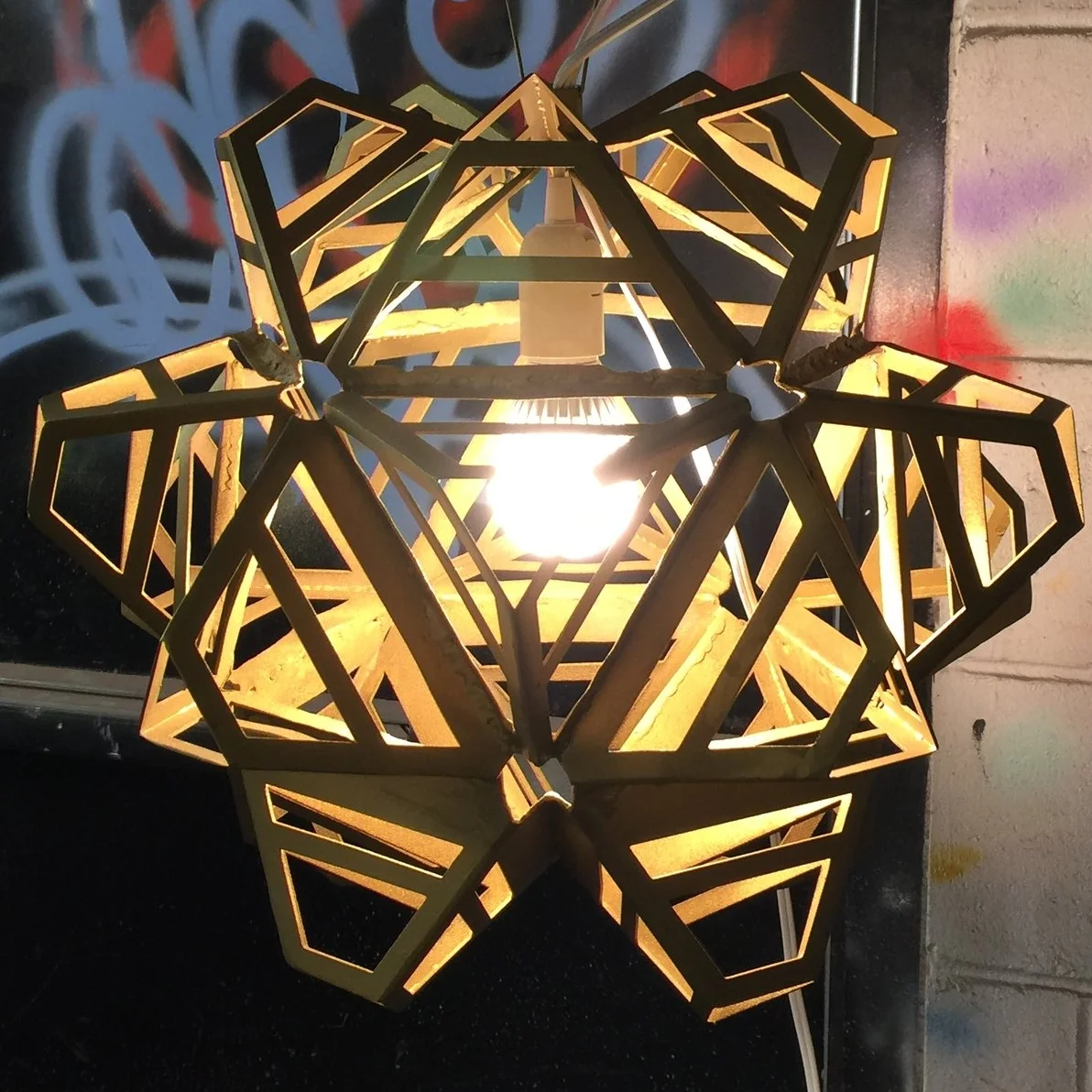
Golden Star Pendant Lamp (November 2017 - December 2017)
Mild Cold Steel, Spray Paint, Fluorescent Light bulb, Magnets
Diameter 14.5 inches

Twisty Cutlery (November 2017 - December 2017)
Rhino File
Knife 10 inches blade: L4 inches X W0.5 inches
Fork 8 inches Prongs: L3 inches X W1 inch
spoon 7 inches Scoop: L1.5 inches X W1.5 inches
Handle L5.5 inches X W0.5 inches

Rocky Moon - Low Rise Chair (Late September - Early October 2017)
Mild Cold Steel
Hammered into shape using a 7-12 lbs hammer with aid of an Oxy-Acetylene Torch

A Set of Cream and Sugar (September 2017)
L9 inches X W5.5 inches X H10.5 inches
Rhino File

Puzzle Table, The 3 Layer Challenge
Materials - Plywood, Spray paint
L22 inches X W13 inches X H6 inches
April 2017 - May 2017

Chipmunk Bench, The Little Critter's "Safe" Spot
Materials - White Oak, Plaster, Spray Paint, Polyurethane
L32 inches X W13.5 inches X H19 inches
April 3, 2017 - May 3, 2017
Seats 1-2 People

8 Foot Shoe Box of Struggle and Excitement
Materials - Bass Wood, Hickory Wood, Manila rope
L96 inches X W8.5 inches X H16 inches
February 2017 - March 2017
Materials: Arduino UNO R3 Starter Kit, DC Motor 10V, 9V Battery, 5V Wall charger, PLA Plastic
Mark Rober’s Class - Electrical & Mechanical
January 2021
Write a list of activities that you need and/or want to do. If possible try to order them by priority. Spin the wheel with a press of a button. When tired of the activity. Spin the wheel again for another. Try to spend at least 10 minutes or more on each activity. This should help focus of the activities that needs to be done while creating awareness of other activities that you wish to do even when you are tired. For me, it breaks the habit of messing around due to decision fatigue and resort to the simplest answer of just messing around and forgetting my other activities that needs to be done. By leaving it to chance on what I should do, I can focus on the task and not on what I feel like doing and whether or not I want to do them. Because the commitment is low I can always spin the wheel again, but only after 10+ minutes. While this requires discipline, it is something I can do as in comparison to before 10 minutes is a lot more than none.